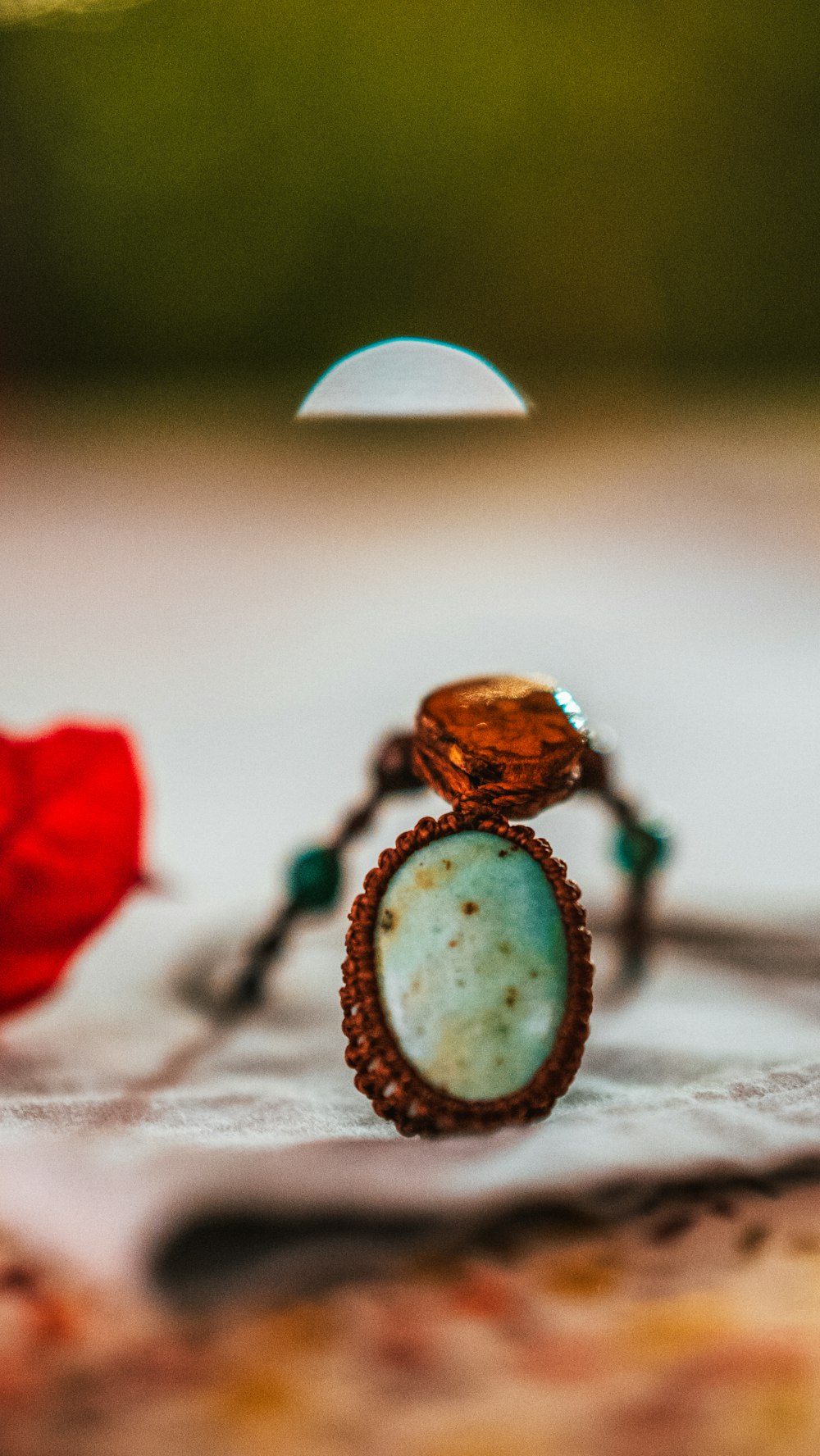
In this day and age of turbulence and chaos, you can use stone power to remain steadfast during the toughest times. Sky blue amazonite is the hope stone of ancient legend and can give you the fortitude to withstand any trials and tribulations.
In this day and age of turbulence and chaos, you can use stone power to remain steadfast during the toughest times. Sky blue amazonite is the hope stone of ancient legend and can give you the fortitude to withstand any trials and tribulations.

First found in the 1800s in Russia, this stone was names after the country’s czar, Alexander. It has since been found in Brazil and Sri Lanka. A mysterious green, alexandrite shines red under light. The phrase “emerald by day, ruby by night” illustrates the color changes of alexandrite. This stone can be of very great value and command a great price if the colors are pure. Alexandrite is good for the nerves and is calming to the wearer. This stunning stone is also a confidence booster and makes a great ring for making a commitment to yourself.

Blue zircon is a thread of the fabric of Greek mythology. In the tale of the Greek youth Hyacinth, a blue hyacinth flower grew in the place where he died. In a less charming but equally fascinating fable, zircon was used for exorcism. The methodology was simple—a cross was cut into a loaf of freshly baked wheat bread. Then, a zircon was used to trace along the cross shape before the bread was eaten to drive away the evil spirits.
One pretty legend relating to turquoise is that is generated by rainbow touching the earth. Turquoise seems to have always had a mythic link to horses, beginning with the medieval belief that anyone wearing this stone would be protected from falling off the animal. Sir John Mandeville’s Lapidaire further claimed that this blue-green stone prevented horses from the harm of drinking cold water when they were sweaty and hot. Turkish equestrians went so far as to attach this crystal to the bridles of their horses as a talisman for the animals.
An unusual story about turquoise comes from the court of Emperor Rudolph II, whose physician was given a specimen that had faded completely. The doctor’s father had given it to him with these words of wisdom, “Son, as the virtues of the turquoise are said to exist only when the stone has been given, I will try its efficacy by bestowing it upon thee.” The young man set it in a ring and in one month’s time, the splendid color was completely restored.

This stripy green stone belonged to the Greek goddess Venus. The Greeks believed it had major magical powers when set in copper jewelry. The Romans switched things around a bit and turned malachite over to Juno, cutting it into triangular shapes to indicate her sacred peacock symbol. My favorite bit of malachite lore is that drinking from a goblet cut from this stone supposedly gave the imbiber understanding of the language of animals!

The ancients were fascinated with magnetite and its mysterious workings. The great Pliny wrote that the first instance of the discovery of magnetite, commonly known as lodestone, happened when a Cretan shepherd was walking on Mount Ida with his flock, and the nails of his shoes clung to a rock in the field. The shepherd’s name was Magnes. Pliny also recorded the tale of Ptolemy, who wished to make an iron statue of a woman for a temple dedicated to his wife and his sister. The trick was that he wanted to use the new art of magnetism to suspend the statue in the air without any visible means of support! Unfortunately for us, Ptolemy and his architect, the Alexandrian Dinocrates, died before its completion. Otherwise, there might have been an eighth wonder of the world. Lodestone, the polarized version of magnetite, was held to be a protection against spells and other magical mischief. The ancients also believed that a small piece of lodestone beneath the pillow would be a testimony to virtue. Alexander the Great gave his soldiers lodestone to defend against unseen evil spirits.

Ancient Babylonians and their south-of-the-Mediterranean neighbors, the Egyptians, could not get enough of this bright blue jewel. The Egyptians named it chesbet and usually included it on their list of VIP items to be paid to nations under the dominion of the great kingdom of the Nile. The Babylonians, who piled lapis lazuli high in their tributes to Egypt, had access to a plentitude of this stone because they were the earliest people to mine it—back in 4,000 B.C.!
Lapis lazuli was so holy to the Egyptians that the high priest himself worse a pendant of the blue stone in the shape of their goddess of truth, Mat. The Egyptians seemingly wished to swim in seas of lapis, as they used it daily— as adornment, for funeral masks and tools, and as an ingredient in their art, traditions that lasted for many generations into the future. Lapis has the unusual ability to hold its pigment even when it is ground up, which leads to what is perhaps my favorite of all the myriad and wonderful uses of lapis lazuli: eye makeup. Can you imagine getting ready for a big night out by painting your eyelids peacock blue with a very expensive lapis lazuli-laced eye shadow? I love the idea, and I’m sure Cleopatra did, too.

Garnets have much lore around them. The ancients believed them to have protective powers that prevented travelers from accidents and mishaps and also kept the sleeping from nightmares and bad dreams. It is said that the fiery glow of a garnet kept Noah and his ark afloat. A popular biblical gem, garnet was one of the stones used by King Solomon in his breastplate. In Asia, garnets were used as bullets, most notably in the rebellion in India in 1892. Garnet’s name comes from the Greek word for pomegranate, and the gem is associated with a Greek myth surrounding this fruit. Persephone, the daughter of Zeus and Demeter, tasted three seeds from the pomegranate, dooming herself to spend half of the year in the underworld, married to Hades, god of the underworld.

Emeralds are believed to have been brought to Earth from the planet Venus. This precious stone is one of the only ones that retains its value, according to gemologists and jewelers, even if it is deeply flawed. Emeralds have a richly varied mythology attached to their glowing green history. For thousands of years, Hindu physicians in India regarded this stone as a benefit to many stomach-related illnesses—it was an appetite stimulant, a curative for dysentery, a laxative, and a treatment for too much stomach-irritating bile. In India of old, they also believed emeralds could drive away demons or rid a body of ill spirits.
Another antiquated belief about emeralds is that they portended events from the future, rather like scrying, or seeing things in a mirror or the glassy surface of the gem. Emeralds were thought to be foes to sorcerers, a belief stemming from a legend that emeralds vanquished all wizardry in their wake. The ancients loved emeralds and connected them with the eyes. Theophrastus, a student of Plato’s, taught that emeralds protected the eyesight. He was taken so seriously that engravers kept emeralds on their tables to look at to refresh their eyes.
Egyptians valued emeralds almost beyond any other stone and claimed their goddess, Isis, wore a great emerald. Anyone who looked upon Isis’s green jewel was assured of a safe trip to the underworld, the land of the dead. Egypt was the main source for emeralds until the sixteenth century. The Cleopatra mines, south of Cairo, were the mother lode, and emerald traders from as far away as India sought the stones, obtained at great human cost under wretched conditions of extreme heat and dangerous underground shafts. I hope the common belief that these stones also protected people from any poison and all venomous serpents was true here. Emeralds were anathemas to snakes, which would supposedly be struck blind by merely looking upon the stones.
In ancient Rome, emeralds were quite sought after by the wealthy class. Nero watched the games in the Coliseum through a set of priceless spectacles made from emeralds. However, with the capture of South America by Pizarro and Cortés, the Spanish in the 1500s made emeralds more available to the Europeans, who had an insatiable appetite for jewels and gold. The discovery in 1558 of the Muzo mine in Colombia uncovered emeralds of incredible beauty and size, prompting the Spanish conquistadors to take over the mine and declare the natives slaves. Perhaps part of Montezuma’s revenge involved the seizure of the emerald mines. Emeralds were a popular cure for dysentery in the sixteenth century when worn touching the torso or held in the mouth. As with all very valuable stones, the people who actually mine them have no access to them unless they are smuggled out of the mines. According to a recent article in National Geographic, however, this is done more frequently than one might think, especially with larger stones. “Almost every high-quality emerald was smuggled at some point in its history,” according to National Geographic.

I love the charming legend that Europeans first discovered diamonds from Africa in the pouch of a shaman, who used them for healing magic. Prehistoric peoples believed they were fragments of the stars and teardrops of the gods.
In the most ancient times, diamonds were worn simply as adornment in their unpolished and rough state. As you might easily guess, diamonds are thought to bring luck, but there is another school of thought purported by diamondphobes who believe that these gems bring sure misfortune. The legend of the Hope diamond is a fascinating history wherein every owner of the royal rock was bankrupted until it was nestled in the safe of the Smithsonian Institution in Washington, D.C.
Diamonds are associated with lightning and with ensuring victory to warriors wearing them. Diamonds are thought to be powerful enough to fend off madness and even to stave off the devil himself ! The medieval mystic Rabbi Benoni believed that diamonds were conducive to true spiritual joy and had power over the very stars and planets in the heavens.
A curiosity regarding most of the lore about diamonds is that they are supposed to be effective only if received as gifts; the outright purchase of a diamond is said to ruin the magic. I don’t agree on this; if I could afford a diamond for myself, I know it would bring me enormous fortune!
Renaissance astrologer and scholar Gerolamo Cardano was wary of the crown jewel of crown jewels. He proclaimed this about the diamond: “It is believed to make the wearer unhappy; its effects therefore are the same upon the mind as that of the sun upon the eye, for the latter rather dims than strengthens the sight. It indeed engenders fearlessness, but there is nothing that contributes more to our safety than prudence and fear; therefore it is better to fear.” Alchemist Pierre de Boniface was far more confident about this queen of crystals, claiming it could render anyone wearing one invisible! Still, other medieval healers and humbugs claimed diamonds could cure poisoning and were themselves a powerful poison if ground up. Perhaps the most obvious unfounded claim regarding diamonds is that they could overcome and cure the plague.

Medieval historian Arnoldus Saxo said that warriors used beryl to help in battle and also reported that it was good for court cases. Saxo was perhaps a bit hyperbolic in his declaration that the wearer of this stone was made unconquerable and smarter and cured of any laziness! Thomas de Cantimpre’s German classic De Proprietatibus Rerum spoke about the power of the stone beryl to reawaken the love of married couples. Early crystal balls were frequently made of beryl polished into spheres, rather like J.R.R. Tolkien’s palantirs used by wizards. The Druids and Celts used beryl to divine the future, and legend has it that Merlin, King Arthur’s magician, carried a beryl ball around with him for exactly that purpose.